Posts tonen met het label rules. Alle posts tonen

maandag 4 januari 2021

Homebrew: Mass Miniature Battle System

Sooner or later, every adventurer will be confronted by the rigors of mass battle, especially when they are in command of a fief. When armies clash, adventurers often take central stage. The outcome of a mass battle can be determined abstractly, as per this post. Alternatively, the engagement can be played out as an epic miniature battle.

These Miniature Battle Rules use a simplified system, in order to streamline play.


Glossary

AB: Attack Bonus
AC: Armor Class
HD: Hits
Hero: An individual miniature representing a single, heroic, individual
ML: Morale bonus
MV: Movement
Stand: one miniature, representing 10 individuals of that type
Unit: multiple stands of the same type, grouped together and performing actions collectively


Stat Blocks

Stand and Unit stat blocks are written in the following format:

AB (attack bonus); AC (armor); HD (hits); MV (move); ML (morale bonus); Special rules

Goblin
AB +4; AC 15; HD 2; MV 30; ML -1; Nimble Escape: Disengage as bonus action

Guard
AB +3; AC 16; HD 2; MV 30; ML +0


Turn Sequence

At the start of each turn, side initiative is determined. Each side rolls a d20, adding the Charisma modifier of the side’s general. The side that rolled the highest can decide the turn order.

On their turn, a side activates all units one by one. Once activated, a unit can move up to their movement and perform one maneuver. A maneuver is similar to an action in standard D&D combat: melee, ranged attack or spellcasting. Once all units of both sides have been activated, a new turn begins.


Movement and Distance

Movement is measured in points. Every inch of distance requires 5 movement points. Conversely, for every point of movement a unit can cross 0,2 inches or 0,5 centimeters. Movement can be broken up to take place before and after a unit’s maneuver.

Disengaging from an enemy within melee range requires an action, unless specified otherwise in the unit’s description. Neglecting to disengage while moving away immediately allows the enemy unit a melee maneuver.

Attacks and Hits

Most of the time, melee attacks are performed by the front stands of a unit. Exceptions are made for units with reach, whereby the second rank of stands is also allowed to make attacks. Ranged attacks can be made as long as the enemy unit that is the target of the attack is within range.

Attacks are made by rolling a d20 for every eligible stand in the unit and adding the unit’s AB per rolled die. For every roll that beats the enemy unit’s AC, a Hit is scored. The total number of Hits is divided by the enemy’s HD, the result is the number of enemy stands slain.

Melee maneuvers are made with Advantage whenever the enemy unit is wedged in between two attacking units.


Clashes

Whenever Heroes on opposite sides meet, there will be clashes. In this case, a regular D&D combat is initiated between the Heroes that are involved and 10 regular units of an adjacent stand as preferred by the side in question. After the clash is resolved, the Mass Battle will resume.


Morale

Once certain conditions are met, a Morale save must be made by the unit. Base DC 10. Failing the save means the unit becomes Frightened. The second time the unit fails the save, the unit becomes Routed and flees the scene. These conditions are:

After losing 25% of the number of stands
After losing 50% of the number of stands
After losing 75% of the number of stands (save made with Disadvantage)
When a unit’s Hero is defeated in a Clash
When confronted with enemies that have a characteristic causing the Frightened condition

Heroes are exempted from making Morale saves.

Rallying Units is possible by Heroes. As a bonus action, Heroes within 10 can make a Charisma (Intimidation) or Charisma (Persuasion) check against DC 10+the number of turns the unit has been frightened and routed. When the check succeeds, the unit may immediately make a new Morale save.

donderdag 16 april 2020

Peoples of the Westerrealm

Although humanity is widespread and the most multitudinous race in the Westerrealm (being primarily of an olive complexion with dark hair, but other skin-tones and haircolours are prevalent as well), it shares the land with a number of nonhuman peoples, recounted here:


Elves
Descendants of their space-faring precursors, the Elves of the Westerrealm are similar to their eastern brethren, the houses that migrated away from the cradle of civilization. In addition, the direct heirs of the Eldar (star-people, in the Elvish tongue), called Nimbus Elves call the Westerrealm home. They make their abode in starlit forests and on mountaintops, hidden by the luminous stars of heaven.


Smallfolk: Dwarves, Halflings and Gnomes
Unlike in the eastern realms, the peoples of dwarves, halflings and gnomes are considered to share a common ancestry here in the Westerrealm, having differentiated on their migratory trail to the land of the rising sun. In contrast to their eastern cousins, the smallfolk of the Westerrealm are not particularly known for their underground existences. They live among Men all across the land, although some stick to the "Old Ways" and live in isolated cabins that hold a single dwarf family. All around, they are less inclined to warfare and fighting than the eastern clans and more industrious and mercantile.
[Author's note: I am considering making the Dwarves of Azurth available as a PC race.]

Smallfolk that take up a life of wandering, either by land or by river, are known as "halflings", for they are always "half-there", always their eyes on the horizon. The smallfolk that live in forests - be they enchanted or not - are known as gnomes. All are known for wearing pointy red caps.


Animalfolk
Called "Therion" in the old tongue, Animalfolk are the second largest population group in the Westerrealm. Some sages even say that the Animalfolk were here before Men or even the Eldar. Not naturally inclined to build cities and civilizations, the Animalfolk live in the cities of Mankind and are differentiated into various animal types, the most common of which include:


Orcs
Common folktales claim that the brown, savage folk known as orcs were once Eldar seduced to evil by dark gods. And for sure, time out of human records, they have been a plague upon the lands of the Westerrealm. Whatever their origin, there is great emnity between the races of orcs on one side and the elves and smallfolk on the other.


Dragonborn
In the days of the Dragon Empire, the race of the dragonborn were the favored warriors, stewards and sages of the Great Dragons. With the fall of that empire, its society and organization collapsed as well and the dragonborn clans took to a life of wandering the Westerrealm. Nowadays, they are a rare sight indeed and only scattered warbands of them remain.


Tieflings
Common in the lands conquered by Phaeton, the Morninglord, tieflings carry a bit of otherworldly blood. They aren't shunned in the Westerrealm like they are in the eastern kingdoms, yet the palpable taste of ash and vinegar makes even the most hardy Burgundy adventurer squeamish at times.

dinsdag 21 januari 2020

5E Domain Game

The players in my Sunset Realm campaign recently reached 10th level and have acquired some fame. They restored the flow of iron ore to the civilized lands and have gained the favor of nobles and kings.

Being a fan of strategic-level play and domain management, I crafted a homebrew set of domain game rules.

Note: Wyld and Temple ratings correspond directly to my Magic in the Sunset Realm rules, so consider that an optional rule.


Fiefs and Followers
Adventurers can opt to found a fief. A fief (domain, province) is a single 48-mile hexagon on the map, controlled by a character. Fiefs are ruled from a holding, either a keep, castle, tower or similar building. Fiefs can be either granted (by a king or lord), conquered, or cleared (in the case of an unclaimed wilderness hex). Fiefs can be held by more than one character, and many adventuring parties share a fief, each member establishing a holding within it.

Fiefs are statted as follows:

Level: an overall measure of population, development and prosperity. A fief’s level is the most important factor. A fief’s population can roughly be determined by squaring its level and multiplying it by 1,000. Most fiefs fall into the level 1-5 range. Only heavily developed areas exceed this range. There is no upper limit to the development of a fief.

Example: Antissa is a level 7 fief. It’s population can roughly be calculated as 7x7, multiplying by 1,000 for 42,000 citizens.

A fief’s level is important when factoring income, as outlined below.

Wyld: A fief’s Wyld rating is a rough measure of its raw arcane background power. The Wyld rating is determined by dominant terrain within a fief as follows:

Badlands/Desert – 3
Hills/Plains – 5
Light Forest – 7
Mountains – 7
Coast – 7
Heavy Forest – 8
High Mountains – 8
Marsh/Swamp – 8

For every level of development of a fief, the Wyld rating is lowered by 1 as the spread of civilization blocks the flow of arcane power through the land. The Wyld rating is directly translated into the maximum spell level that can be cast by bards, eldritch knights, arcane tricksters, sorcerers, warlocks and wizards within the fief.

Note: Elven settlements do not hamper the flow of arcane energy throughout the land. Their architecture allows the Wyld to flow unhindered.

Example: the harbor of Oronis lies near the coast. It is however a fief developed to level 3, lowering the Wyld rating of the area by the same amount. The Wyld rating of Oronis and surrounding area is therefore 4, allowing a maximum of level 4 spells to be cast by arcane spellcasters.
The domain of Arbor, within Arbor Forest, is a level 3 fief. But because it is a Wood Elven settlement, its development does not hamper the flow of arcane magic. Its Wyld rating thus remains 7.

Temple: A fief’s Temple rating is an abstraction of its religious devotion, measured in devoted souls, faithful congregations and religious buildings. A fief’s Temple rating can never be higher than its level. A fief’s Temple rating corresponds directly to the maximum level of spells that clerics, druids, paladins and rangers can cast.

Example: Antissa is home to the Celestial Mountain, a center for religious worship throughout the Alliance. It has invested heavily in religious institutions and boasts a devout population. Antissa’s Temple rating is 7, maximally developed, and therefore allows the casting of level 7 divine spells.

Contentment: An abstract measure of the population’s general attitude towards its rulers, contentment has three stages:

Friendly: the population is generally supportive of its government.
Indifferent: there are complaints, but at least the government is trusted to provide protection and vital services.
Hostile: there is widespread unrest, the population is one step short of open rebellion.

If contentment drops below Hostile, the fief is considered in open rebellion and provides no income or troops for its holder.

A fief’s contentment level can be influenced by the actions of its ruler(s). Charismatic rulers often have an easier time than uncharismatic ones to retain their population’s favor. Contentment can be increased by a month’s long campaign, requiring large amounts of money, public works or the staging of spectacles. Alternatively, the fief’s holder can quell the unrest by the deployment of troops. The ruler makes a Charisma check at the end of the month (modified for a particular skill, with a DC set by the DM based on the contribution made by the ruler). If the check is successful, contentment rises by one step.

Example: Aurora generally has an Indifferent attitude to its rulers, being a metropolis recently resettled with a frontier mentality. Recent events have spread unrest among the population, and its contentment has become Hostile. Aurora’s ruler, the Warforged known as the Primary, seeks to quell the unrest and institutes a strict regime of zero tolerance. After a month of cracking down on unrest, the Primary makes a Charisma (Intimidation) check to try and raise Aurora’s contentment back to Indifferent.


Fief income
All fiefs not in rebellion against their rulers provide income to their holders. At the end of a month, a fief’s holder can choose to levy tax on his fief. He can choose either light, moderate or heavy taxation. The severity of a levy determines the size of the dice to be rolled, the fief’s level determines the amount of dice rolled, 1 per level.

Light d4
Moderate d6
Heavy d12

The total rolled, multiplied by 100, is the amount of gold collected that month.

Levying moderate taxes reduces the fief’s Contentment one level. Levying heavy taxes reduces Contentment two stages. Choosing to forego taxation raises the fief’s Contentment level by one stage.

Example: Antissa, a level 7 fief, needs to pay for wartime expenses against marauding elves. King Kenneth levies a moderate tax, rolling 7d6 to determine income. He rolls a total of 27, thereby collecting 2,700 gp for the treasury but incurring the ire of the population. Antissa’s normally Friendly population becomes Indifferent.


Followers
Any adventurer with a holding in a fief that has reached 9th level in a single class attracts followers, as per the following table:

Barbarian 1d4+1 x10 tribal warriors
Bard 1 special (determined by DM), 1d6 scouts
Cleric 2d6 acolytes, 1d4+1 x10 guards
Druid 1 druid, 2d6 scouts
Fighter 2d6 veterans, 2d4+2 x10 guards
Monk 2d6 martial arts adeptsVGTM
Mystic 2d4 special (determined by DM)
Paladin 1 special (determined by DM), 2d4 knights
Ranger 1d4+1 x10 scouts
Rogue 2d6 spies
Sorcerer 2d6 apprentice wizardsVGTM
Warlock 1d3 special (determined by DM)
Wizard 2d6 apprentice wizardsVGTM

Followers require upkeep consisting of 2 gold pieces per day, in addition to lifestyle costs.

donderdag 16 januari 2020

5E Henchmen rules

I rather like the D&D Essentials Kit's take on Sidekicks. The Essentials Kit uses sidekick-rules to provide a way in which the game can be experiences one-on-one. But there is no limitation on a party of adventurers enlisting sidekicks.

In my Sunset Realm campaign, I use the Essentials sidekick rules as a modern interpretation of the old 1E/Basic Henchmen rules. For that to function, use the rules from the Essentials Kit on sidekicks (or the Unearthed Arcana version, for more variety) and consider the following:

All adventurers, being gifted with dangerous allure, are able to enlist Henchmen to their cause. Henchmen are confidantes, lieutenants, aides and apprentices. An adventurer can retain one henchman without penalty. Each additional henchmen brings a cumulative -2 penalty to Loyalty for all henchmen. The maximum number of henchmen an adventurer can retain is equal to 1+Charisma modifier (minimum 1). Henchmen are controlled by players, unless the DM intervenes or decides otherwise.

Henchmen come in three classes: Experts, Spellcasters and Warriors. Henchmen earn XP just as Player Characters do and level up just as PC’s do.

Retainer: Henchmen don’t join adventurers out of charity. They require attention from the PC they are loyal to, as well as a daily stipend of gold pieces equal to its level and lifestyle costs. To increase loyalty, PCs can choose to dole out shares of treasure gained from adventures.

Loyalty: A henchman’s loyalty is a score ranging from 1 to 20. A henchman’s maximum loyalty score is equal to the Charisma score of the retaining PC. Loyalty normally fluctuates by 1d4 up or down, according to the PC’s treatment of the henchman. If the PC helps the henchmen attain a goal related to its ideal or bond, loyalty increases by 1d4. If the PC works counter to the henchman’s bond or ideal, loyalty drops by 1d4. If the henchman is treated badly or dismissively by the retaining PC, loyalty drops by 2d4. If the Loyalty score reaches 0, the henchman abandons the PC. When loyalty is 10 or above, the henchman goes above and beyond the call of duty in service to the PC. Starting Loyalty is half the PC’s Charisma.

Example: Ferrek has a Charisma score of 15. The maximum loyalty of his henchman Pluck is therefore 15. When he hires Pluck, the henchman’s score is 7. Pluck’s ideal is freedom. Whenever Ferrek helps Pluck to feel free or free others, Pluck’s loyalty increases by 1d4, to a maximum of 15.

What do you think? Let me know in the comments!

maandag 6 januari 2020

Old-school style XP in D&D 5E

Beedo at Dreams in the Lich House has unleashed a debate on the XP-system of 5th Edition D&D. In his post, he riles against the Adventurer's League system of using milestone XP (and in my opinion, rightly so). But he considers 5th Edition's main system of earning XP via defeating foes in combat a fail also. And I agree.

Since stumbling on the OSR years ago, I have become enamored of old school play style, if not the systems. Whereas AD&D 2nd Edition brings fond memories to my brain, I have never blayed OD&D or any B/X variants. I thoroughly enjoy 5th Edition and, more importantly, my players do as well. But gaining XP only through combat is simplistic and promotes the wrong kind of problem-solving.

At my table, I expect my players to be clever, to avoid combat. I believe the XP-system of a game should reflect the in-game goals. Therefore, in my campaign, I award XP as follows:

Experience
Adventurers gain Experience Points (XP) by gathering forgotten treasures from dark dungeons. For every gold piece (gp) of value that an adventurers brings back to civilization he gains 1 XP. Experience is awarded when PC's return to their home base.

Adventurers also gain XP by committing the following acts:

- saving captured innocents from harm: XP value of defeated foe(s)
- defeating evil priests or sorcerers: XP value of defeated foe(s)
- disrupt vile rituals: XP value of defeated foe(s)
- killing aberrations or undead: XP value of defeated foe(s)
- eliminate conspiracies: XP value of defeated mastermind
- mapping the world: gp value of map in XP (125 gp/30 mile hex)
- mapping dungeons: gp value of map in XP (25 - 6600 gp)

Individual adventurers can gain XP by committing the following acts:

- win a duel: XP value of defeated foe
- end a personal vendetta: XP value of defeated foe
- providing a service for one's mentor: variable
- achieve a short term goal: 50 XP/level
- achieve a long term goal: 150 XP/level
- eliminate an obstacle to a personal goal: XP value of defeated obstacle/foewijderde obstakel

Inspiration
In addition to Experience, adventurers are awarded Inspiration for the following acts:

- accepting a duel
- taunt an enemy with words
- carousing
- a stylish move in combat
- a surprising moment in the game

This system is not perfect, but it reflects my personal preferences and promotes an old school, adventurous approach in the players.

What system for XP do you use?

maandag 2 december 2019

I made a thing!

The Trader Rogue Subclass has been altered and is now for sale on DM's Guild. It is my first officially published title on DM's Guild and I expect more to follow.

Get it here!

maandag 22 april 2019

A Trader subclass for 5E

In the deserts of Athas, the setting of Dark Sun, great merchant houses ferry the goods needed to survive from city to city. The characters that serve a key purpose in these merchant houses are the Dune Traders. 

In the post-fall wilderness of Draconis, trading goods between communities has become essential to survival. In the Plaguelands, the powerful faction known as The Guild is only just now emerging on the forefront. With a strong presence in Trade Town, the Guild is a key organization in the supply, survival and travel needs of the communities of the Plaguelands. With dozens of thieves, assassins and vagabonds in its employ, it is also a network of less reputable individuals. None are so valued however as the Traders


TRADER is an archetype for the 5th Edition Rogue class. Traders are rogues that specialize in merchandise, profit, social contacts and negotiation. Without Traders, the economy of the post-apocalyptic wilderness communities would quickly collapse. They provide a strong network of tightening economic dependency between the communities. As a Trader, you quickly grow into an economic linchpin of your party.

Bonus Proficiencies
At 3rd level, you gain proficiency in two skills or artisan's tools of the following list: Deception, Insight, Intimidation, Persuasion and Calligrapher's Supplies, Cartographer's Tools or Jeweler's Tools.

Fast Talk
At 3rd level, you gain the ability as a bonus action on your turn, to make a Charisma (Persuasion) or (Deception) check, opposed by the target's Wisdom (Insight) to talk your way out of sticky situations. You can use your fast talk in bargaining situations or to gain advantage on your next attack roll.

Trade Tongue
At 9th level, you learn two additional languages. You are implied to have learned these languages in your career as a trader. They can be common as well as exotic languages.

Exceptional Contact
During your adventures, you have made contacts with various communities and organizations. At 13th level, one of these contacts - either a warlord or guild leader or community leader - develops into an exceptionally strong ally. At any time, you can invoke this ally's aid in a situation. For all intents and purposes, the ally acts as if under the influence of Charm Person

Leverage
At 17th level, your contacts, trading partners, personal standing and credit and personal wealth are such that you can immediately procure any service (including spellcasting services, as per the PHB's chapter on Equipment) you want. In addition, you can maintain an aristocratic lifestyle at no cost and suffer no expense for food, drink and lodging.


donderdag 11 april 2019

The Siege of Antissa part 3 - Opening Moves

Prince Evander, his nephew Prince Leolar and the Duchess Ylsandre have drawn up their forces outside of the City of Antissa, capital of the Alliance, demanding forceful entrance. Inside of Antissa's walls, King Kenneth has shored up his defenses. Thousands of citizen-soldiers stand ready to defend their home. At the start of the first week of the siege, each party's actions are as follows:

Antissa (BR 170)
Though Antissa is a large city, high-level wizards and sorcerers are rare. Only 1 in 128.000 attains that level and Antissa's archmage Tenser is missing. The city is therefore unable to teleport in food at the moment. The city does have access to the priests of the Celestial Mountain, five of whom are able to provide food daily to a total of 75 people. In addition, High Ecclesiarch Terenas Vayder is able to provide for 120 people each day and will pray for Divine Intervention from Bahamut. Antissa has prepared six months of food for storage (7,2 million units) and Kenneth immediately rations that to food once per 3 days for commoners. Soldiers get a full allotment each day. Water can be supplied from the springs beneath the Celestial Mountain. In total, Antissa loses 108,600 food units each week. At this rate, Kenneth can hold Antissa for 66 weeks - more than a year!

In terms of siege actions, Kenneth chooses to Harras the Elven forces.

High Elves (BR 160)
The Elves have just arrived on the field of battle, without siege engines and with only meager supplies. They currently have enough food to feed their numbers for two weeks. In their first day, the Elves scour the countryside to extend their stores for an additional week. During the rest of the week, four heavy catapults (+8 BR) are constructed.

The first week of the siege
Though Terenas prays for Divine Intervention each wake, his prayers go unanswered.
Kenneth's harrasment of Evander's forces results in the first skirmish of the siege. Kenneth rolls a 19 on a d100 for a total Battle Result of 170+19 = 189. Evander rolls a 25 for a total of 185. Kenneth has caught the Elves while they were still settling in!

But his succes is only marginal. 20 Elves are killed, another 20 wounded. 3,960 battle-ready Elves, under the command of three formidable spellcasters, still remain...


maandag 8 april 2019

The Siege of Antissa part 2 - Defenses and Siege Engines

Basic D&D's War Machine had an addendum rules set called Siege Machine, developed specially for sieges. Using the Siege Machine rules, we will further chart the course of the Siege of Antissa.

Defenses
Antissa is an old city-state and has survived multiple extended wars, magical conflicts and even divine intervention. Its defenses are formidable and consist of the following:

- 4 cannons* +12 BR
- 3 trebuchets +12 BR
- 8 ballistas +2 BR
- in stronghold +50 BR

Each weapon has enough ammunition for a year's worth. King Kenneth is not a risk taker.

Furthermore, Antissa's army outnumbers Silvanor's army 1,5 to 1, yielding an additional +15 BR. Furthermore, Antissa is defending its own domain and receives a +10 BR for morale.

*In the original Siege Machine rules, cannons were not listed. In my campaign, cannons are very real. Comparing the 5E statistics on page 255 of the DMG yields the cannon as dealing the same amount of damage as a trbuchet. In Siege Machine, a trebuchet gives a +12 BR, therefore, the cannons give a +12 BR each.

Elven siege equipment
The High Elves of Silvanor are only fresh out of a home and have hurried to their former-ally. In their hurry, the forces of Evander have not yet been able to construct siege engines.
The Elves additionally receive a +10 bonus for their superior quality against Antissa's citizen army.


Final Notes
As Prince Evander arrives at Antissa's gates, the Battle Ratings of both forces stand as follows:

Antissa: 170
Silvanor: 160

vrijdag 5 april 2019

The Siege of Antissa part 1 - Mustering the Forces

As described in my last post, I will attempt to convert Basic D&D's War Machine rules to the Sunset Realm. The capital city of Antissa is under siege by High Elven forces who are pissed at the loss of their homeland. As the PCs are currently far away, investigating a dark tower and having been warned by Antissa patrols not to come near the city, the siege is happening mostly offscreen. And though I love miniature battles, playing solitary is not one of my hobbies. Therefore I turn to War Machine to determine the fate of Antissa and the High Elves.

The strength of forces in War Machine is determined by calculating the Battle Rating (BR) of a troop. The Battle Rating is determined by a number of factors: leadership, experience, training, equipment and special circumstances.

Antissa
Antissa's army is composed of a force of trained citizens (4,500), the Red Guard (1,500) and the King's Pistoliers (100). In addition, King Kenneth commands four airships and possesses a few formidable cannons on the city walls.

Leadership: the determining factors in leadership are the commander's level and his Intelligence, Wisdom and Charisma modifiers. In the case of Antissa, King Kenneth himself is a capable war leader, a 9th level Paladin. His Intelligence is 13, his Wisdom 11 and his Charisma 17. Antissa's leadership factor is 13.

Experience is factored by both the average level of the officers in the force as well as the level of the troops. Most officers (whether knights or veterans, both out of the 5E Monster Manual) still have a +2 proficiency bonus, implying that their level cannot be higher than 4. Considering Antissa's martial tradition and excellent training facilities, let's state that the average officer level is 4. Multiplying by 3 as per the War Machine rules gives us a rating of 12.
For the troops, the average level must be multiplied by 2 to calculate the rating. Antissa's army is well trained but not exceptional.  Let's set the average level at 2 to get a rating of 4.
In addition to these factors, a +1 is added for every battle won in the last 10 years and a -1 is factored in for every battle lost in that same time. In my campaign, during the War with Aurora a few years ago, Antissa's army lost the first battle but won the siege and the ensuing field battle. For these experiences, a total of +1 is added to the experience battle rating for a total of 17.

Training: for every week spent in training the last year, +1 may be added to the factor, up to a maximum of 20. Antissa's army is highly disciplined so may apply the full +20 to the battle factor. For every week that the commander trains with the army, an additional +1 may be added up to a +20. King Kenneth is a capable war leader, yet his royal duties prevent him from spending a full training regimen with his armies. He spends one week every moon with his troops, providing a +12 to the battle factor. An additional +1 may be gained for every month the troops as a whole are on duty and not in their homes or forts. As Antissa's army is a citizen army, this factor does not apply. Antissa's total training factor is 32.

Equipment: the quality of equipment determines the last major part of the battle factor. Average quality equipment provides 5, good quality 10 (double the base cost), excellent quality (triple the base cost) 15. Antissa is a rich kingdom and has a well-maintained armory, yet also suffers from the iron shortage that grips the land. As such, the equipment factor is "only" 5.

Adding all these numbers yields a Basic Force Rating of 67, which reads as "Fair" on the Troop Class Table.


The besieging High Elves
The 4,000 strong High Elven army is commanded by Prince Evander, seconded by Prince Leolar and Duchess Ylsandre (King Kenneth's grandmother). Evander is 11th level Fighter/Wizard with Int 20, Wis 11, Cha 14. Leolar is a 9th level Eldritch Knight and Ylsandre is a 9th level Wizard (Enchantress). The Elven leadership factor is 18, +4 for two level 9+ officers for a total of 22.

The High Elven forces are slightly more experienced in matters of war than their human opponents, having held the glades of Silvanor against goblins, monsters and other scum for centuries. Let's set the officers' average experience level at 6 (for 18) and the average troop level at 4 (for 8). For all their experience, the Elves haven't had to fight in a major battle for decades so they gain no additional bonus or penalty. Their experience factor is 26.

The Elves are rigorous soldiers and martial training is part of their routine. As such, both the troops and their leader Prince Evander train regularly and gain the full +40 bonus to the battle factor. They have been fighting together for a month in the field now, for a +1 bonus. The Elven training factor is 41.

Taking care of your ancestral weapons and armor is part of the High Elven martial training. As such, the Elves are in possession of "good" quality weaponry for a factor of 10.

Special: in War Machine, certain troops gain a bonus to the battle factor depending on ancestry. Dwarves and Elves receive an additional 15 points to the battle factor. Monsters with certain special abilities (such as spectres, dragons, etc) gain an additional 2 points. As an Elven army, Evander's forces gain 15 points.

Adding all these numbers yields a Basic Force Rating of 114, a quality of "Excellent" on the Troop Class Table.


Determining the final Battle Rating (BR)
War Machine further accounts for force composition by adding 1/10th of the Basic Force Rating to the Battle Rating every time one of the following statements is true. For ease of reference, I have copied the statements here to account for both Antissa's and Evander's armies.

Mounted:
a. 20% or more of the force is mounted. (Antissa Y/Elves N)
b. 40% or more of the force is mounted. (Antissa N/Elves N)
Missiles:
c. 20% or more of the force can use missile fire. (Antissa Y/Elves Y)
d. 20% or more of the force has a missile fire range of 100' or more. (Antissa Y/Elves Y)
Magical:
c. 5% or more of the force is equipped with magical abilities. (Antissa N/Elves N)
f. 20% or more of the force is equipped with magical abilities. (Antissa N/Elves N)
g. 100% of the force is equipped with magical abilities. (Antissa N/Elves N)
Spells:
h. 5% or more of the force can cast spells. (Antissa N/Elves Y)
i. 30% or more of the force can cast spells. (Antissa N/Elves N)
Flying:
j. 1% or more of the force can fly. (Antissa Y/Elves N)
k. 20% or more of the force can fly. (Antissa N/Elves N)
Speed:
l. The force has an average movement rate of 35' per round (or more). (Antissa N/Elves N)

Antissa can add 4 times its BR bonus of 7 for a total Battle Rating of 95.
The Elves can add 3 times their BR bonus of 12 for a total Battle Rating of 150.

Join me next time, as we consider Antissa's defenses and the siege engines of the High Elves.


dinsdag 18 december 2018

Magic of the Sunset Realm

The world is steeped in a power known as the “Wyld”. It is a magic force that flows through the land and collects in places of unspoiled wilderness. Those of high learning or willpower can tap into this flow, shaping magic into spells. The first creatures to have a grasp of this power were the Dragons.

Ancient glens, misty valleys and stark mountains are places where magic flows strong, allowing for the mightiest spells. Consequently, the building of roads, bridges and the trappings of civilization diminish the flow of magic. Where population is high, magic power is almost nonexistent and only the weakest cantrips can be cast. 


Magic of the Land
The maximum level of spell slot your arcane caster can use is defined by the terrain hex he is in:

Badlands/Desert – 3
Hills/Plains – 5
Light Forest – 7
Mountains – 7
Heavy Forest – 8
High Mountains – 8
Marsh/Swamp – 8

This maximum is lowered by human habitation. For each “level” of civilization (approximately 5,000 people), the land’s power is diminished by 1.

Places of Power & Ley Lines
The most magical  parts of the Sunset Realm are untouched by human civilization: undespoiled groves, mountaintops, deep swamps. In the heart of these regions, the Magic level is considered +1.

There are also rumours of a Dragon’s Graveyard where the mightiest spells can be cast naturally.

Ley Lines forged by powerful arcanists crisscross the land, funneling power of magical sources to where civilization is thick.


Residuum, Wyldstones and Relics
Sometimes, magic power collects into a single rock or earthen formation in the heart of an ancient place of power. These stones, concentrated ingots of residuum, can be mined and are powerful items. They are essential in the creation of magical objects and the ore from these formations is used in the forging of magic swords and armor.

Wyldstone or 1,000 gp of residuum grants an arcane spellcaster +1 to the maximum level spell slot he can use in the current terrain. The residuum is consumed by the spell.

Holy Relics grant divine casters the same boon.


Temple Magic
The maximum level of spell slot a divine caster can use is defined by the level of temple holdings in the current terrain:

Unsettled – 0
Chapel/Grove  – 1
Church/Menhir – 3
Temple/Stone Circle  – 6
Cathedral – 8

Temple development is limited by the “level” of habitation, only the most heavily populated hexes can support cathedrals.


Reavers
Magic is a powerful natural force, but it can also be subverted and warped. This kind of magic is known as Reaving and its users are considered vile and abhorrant.

Reavers tap the very lifeforce itself to power their spells, increasing their capacities above and beyond what the land or accumulated belief around them allows and risking everything in the process.

Every time a spellcaster uses a spell slot higher than the power of the land (for arcane casters) or belief (for divine casters) allows, roll 1d20 + the level of the spell slot.

1-11 no effect 
12-15: caster is poisoned by residuum until cured and gains a short term madness
15-17: caster gains a level of Exhaustion which can only be magically cured and gains a moderate madness
18-20: caster gains a mutation and an indefinite madness
21+: area around caster turns into residuum for miles, caster becomes petrified into residuum


Reaver Mutations:
1 – Small horns on forehead
2 – Eyes turn an unnatural color (red, black)
3 – Legs turn into animal legs
4 – Tail (unusable) appears
5 – Skin turns unnatural color or translucent
6 – Mouth mutates into something unspeakable – unable to speak

maandag 8 oktober 2018

The Compendium Hack

...or "How I Play 2nd Edition AD&D".

1. 3d6 assign ability scores

2. PHB 6 standard races + Tieflings (Planescape) + Half-Orcs (Greyhawk)

3. Classes: standard PHB + Barbarian (Warrior group) + Sorcerer (Wizard group, 3E tables) + Monk (Priest group, Scarlet Brotherhood) + Assassin (Rogue group, Scarlet Brotherhood).

4. Favored classes: Unlimited advancement in the following classes:
 - Dwarf: Fighter
 - Elf: Mage
 - Gnome: Illusionist
 - Halfling: Thief
 - Half-Orc: Barbarian
 - Half-Elf / Human: ALL

5. Humans are the only race that can dual-class and always gain +10% XP bonus

6. Cantrips and Orisons: 0-level spells for Priests and Wizards (3E tables)

7. Advantage / Disadvantage and Inspiration (5E) instead of penalties and bonuses

8. Simple Encumbrance (LotFP)

9. Wizards HD is changed to d6; Rogue HD is changed to d8.

10. Weapon proficiencies by Weapon Groups:
-Blades: All swords, daggers, knives

-Bows: longbows and shortbows
-Crossbows: all crossbows and firearms
-Cleaving and Crushing: axes, maces, mauls, hammers
-Flails: Chains, flails, whips
-Polearms: Glaives, halbers, spears, staffs
-Throwing Weapons: Darts, shurikens, throwing axes
-Unarmed

11. Extra group XP: 1XP per 1gp of treasure recovered

vrijdag 5 oktober 2018

On the Feel of (A)D&D

...or "Why I Miss Second Edition".

This is a pretty pretentious title for a post - Why I miss 2nd Edition AD&D. In OSR circles, AD&D 2E is pretty much the most reviled, despised and shunned set of D&D rules in the 40-year history of the game. Still, it is the edition that holds the most value for me not only because of nostalgic reasons but for gameplay reasons as well.

Memory lane
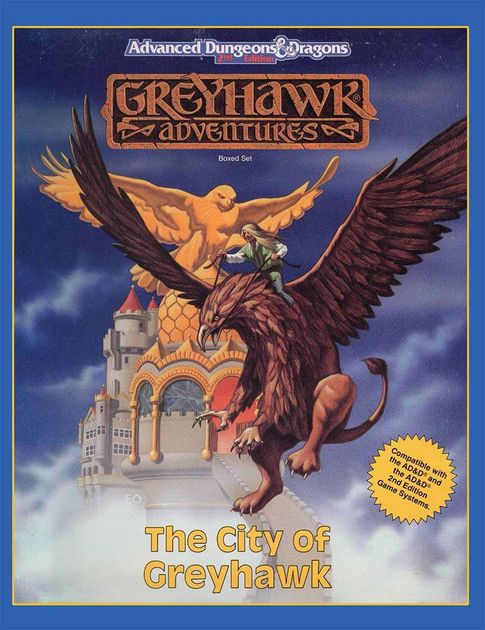
Let's get the obvious out of the way. I began playing roleplaying games in the spring of 1997. My brother lent me a mysterious boxed set with a griffonrider and a faux-stonework logo on the cover. This was my entrance to the City of Greyhawk and years of adventures exploring that metropolis and meeting its denizens.

Afbeeldingsresultaat voor city of greyhawk box

Soon after, I received the Revised Player's Handbook (black border) and a set of polyhedral dice and every saturday my friends and I were exploring this fantastic continent of Oerik.

In the fall of the same year, a Friendly Local Game (and Comics) Shop opened in my hometown and with the money I saved from my allowance and my job delivering flyers I purchased a campaign setting of my own - the Planescape Campaign Setting.

TSR2600 Planescape Campaign Setting.jpg

In the years between that purchase and the release of 3E in august 2000, we played the heck out of Planescape and Greyhawk, frequently crossing over between them. Other favorites of that time when we could spend whole saturdays on gaming were Dark Sun, Spelljammer and Ravenloft. Our group never cared much for the Forgotten Realms, seeing it as a more vanilla incarnation of the more evocative Greyhawk setting.

Al these campaigns were created using AD&D 2nd Edition-rules and we played the shit out of them.
In short: 2nd Edition was the edition on which me and my friends cut our theeth roleplaying. It allowed us to imagine these grand and fantastic worlds, spiralling away into infinity.


The Last Real Edition of D&D
We embraced Third Edition when it launched in 2000. We were 14- or 15-year-olds and immediately grasped the more streamlined and focused design of the d20 system. For the lifetime of that edition, it was our go-to ruleset. I ran my first homebrew campaign in 3E and my most memorable characters were created using the 3E ruleset. And it felt great - the d20 resolution mechanic, the more powerful races and classes, the ability modifiers - everything was streamlined and computated and balanced and intuitive. It was only later, when 3E grew into the abomination that was 4E and then reconstituted itself in 5E that I realized - the editions of D&D published by Wizards of the Coast didn't feel like D&D anymore.

When you're fifteen years old, you immediately see the opportunities in min/maxing your character, finding the optimal distribution of ability scores, feats and skills, and all the other moving parts of 3E.  We were overwhelmed with possibilities and options. And yes, ascending AC was awesome and easy. But as I look back, the game we played from 2000-onwards wasn't D&D.

Where were the ability score requirements, the different rates of advancement for various classes, the rules for strongholds and followers? But most of all, I missed the relevance of the six ability scores. Sure, with the derivated modifiers the abilities were more central to the game than before, but increasingly in 4th and 5th Edition, the game became about the modifiers. Why hold on to scores of 3-18, when the actual math revolves around the -4 to +5 modifier?

The old school Roll-mechanic for ability scores made perfect sense to me. A fighter with a 14 Strength? Your Strength check succeeds on a 14 or lower. A mage with a 17 Intelligence? Your Intelligence check fails on an 18+.

Third, Fourth and Fifth Editions are great roleplaying games with some amazing concepts, expansions, settings and adventures. They just aren't D&D to my taste.


Sheer Volume
Lastly, Advanced Dungeons & Dragons 2nd Edition is my favourite edition by sheer volume. The 2E-era saw the release of a new Forgotten Realms, Spelljammer, the Ravenloft setting, a new Greyhawk, Dark Sun, Al'Qadim, the Historical Reference series, the Complete Player's Handbook series, the Dungeon Master supplements, an updated Dragonlance, Planescape and Birthright. It was the most prolific of editions and many themes and memes of newer editions harken back to AD&D 2E.

In Closing
I started roleplaying games with AD&D, 2nd Edition. I cut my teeth on Greyhawk, Dark Sun and Planescape. I still seek to roll under my Strength score to succeed at a Strength check and I see ability score requirements as blessings rather than penalties. I miss Second Edition AD&D.