Posts tonen met het label Greyhawk. Alle posts tonen

zondag 12 september 2021

Greyhawk Wars

Greyhawk Wars was part of TSR's push to reinvigorate the Greyhawk line in the early 90s. Taking on Carl Sargent, the company had decided that after Dragonlance and Forgotten Realms had filled similar niches in the genre of fantasy, something had to be done to push Greyhawk forward. According to Jeff Grubb, fellow TSR developer Douglas Niles took his suggestion to "burn it to the ground" literally (spawning the myth that Grubb had it in for the venerable setting), and TSR decided an epic shakeup was in order, giving birth to Greyhawk Wars and producing the From the Ashes boxed set.

The game Greyhawk Wars has gotten someting of a bad rep in Greyhawk- and old school-circles, with grognards claiming that Wars blew up the setting and saw it drifting permanently away from Gygax' original vision.

I disagree.

Greyhawk was always a war-heavy setting, having been developed from a miniature wargame and the pages of Dragon magazine saw reports of troop movements and army strengths. Gygax inevitably led the nations of the Flanaess to war. True, a fantasy world war is maybe a bit of a stretch, but the conflicts - between Iuz and Furyondy, Nyrond and the Great Kingdom, the hidden danger of the Scarlet Brotherhood - were present even in the original Folio-edition.

Now the game itself surely has its flaws. But it is an enjoyable wargame. Last sunday, a few of the D&D-group came over early to try their hand at dominance over the Flanaess.


I set out the map, country cards and counters the evening before the game. As I let the players choose the countries that they played, I set out all the options: 

  • Iuz and the Horned Society
  • Furyondy and the Shield Lands
  • Great Kingdom and the Sea Barons
  • Nyrond and Almor
  • Scarlet Brotherhood and the Sea Princes
  • Keoland


Of all the starting countries, Keoland is by far the weakest, and Scarlet Brotherhood allied with the Sea Princes is a close second. As I had tree friends coming over, it was to be expected that they chose Iuz, Furyondy and Nyrond as starting countries. I was left with the Great Kingdom.

It is interesting to note that there is a great disparity in starting forces. Great Kingdom for example, has a large number of troops at the start of the game, while Furyondy and the Shield Lands have to scrounge the lands for defenses. 

We set the victory condition for the game: 20 countries per alliance. Whichever side, Good (Furyondy and Nyrond) or Evil (Iuz and Great Kingdom) managed to control 20 countries first and hold them at the end of a turn would win the game. We never arrived there because of time constraints, but it was nevertheless a good game - though it only lasted two turns.


Observations

What follows is some observations about the game:

  • The game is actually two games: a western front and an eastern front. The war is fought between Furyondy and Iuz and between Nyrond and the Great Kingdom. There is little interation between the two halves of the map. Only the forces of Iuz (operating out of Stonefist on the eastern front) enter a little bit on the war between the Aerdy kingdoms. 
  • It is a race over territory. Only in the second turn did we discover how easy it is to conquer countries and add them to the number of countries controlled by your alliance. By raising armies, splitting forces, occupying areas and declaring them conquered, one can easily expand one's empire. As the Great Kingdom, I discovered the entire eastern seaboard open to my troops (ferried across the Solnor Ocean by Sea Baron shps). To the west, Furyondy's player, after allying with Keoland, Celene and two Ulek states, had enough forces to waltz across Geoff, Sterich, Bissel, Gran March and the rest of the West.
  • Hero Actions are important but not decisive. During the Action Phase, hero counters can engage in diplomacy, fight monsters and discover treasure, or recruit mercenaries. But all of these have a significant chance of failure. Even with friendly states, the chance of alliance is 50/50. Defeating a monster happens only on a lucky roll of the dice. And if you draw a mercenary card of the opposite alignment, then the action is lost. Yet if an alliance, a treasure hunt or a recruitment succeeds, it is significant. During our game, Nyrond conquered both North and South Province and subsequently allied two Iron League states, surrounding my Aerdy forces. Furyondy succeeded in allying with Keoland, Celene and Ulek, providing the western forces of Good with a significant advantage in numbers. 
  • Be careful with your armies. A rash battle can result in the destruction of a significant number of troops, which take two turns to compensate in relation to enemy players. The game gives you the option to retreat at the end of every combat round. A wise empire-builder knows when discretion is the better part of valor.


Conclusion

In the end, the forces of Good, mainly due to the efforts of the Furyondy-Keoland-Celene-alliance, succeeded in controlling 10 countries at the end of turn two. We had to end the game there because our regular D&D-game was about to start and players were already arriving. Both Iuz and myself are brooding on vengeance, however, so we all expect the Greyhawk Wars to resume somewhere in the next couple of weeks.

vrijdag 30 juli 2021

Greyhawk Facts: the Howling Emptiness of the Flanaess

 As has been eloquently been put forth before by, among others, Chris Kutalik of Hill Cantons fame and Joeseph Bloch the Greyhawk Grognard, the lands of the Flanaess are maddeningly uninhabited. As part of a series exploring the implied setting of AD&D 1st Edition, Kutalik wrote an enlightening blogpost on the empty land as presented in the Greyhawk Folio: 

"If you actually sit down take all the distances and stated populations at face value and start crunching numbers, your immediate impression will be that the lands of Flanaess aren't just stable, if embattled faux medieval nations, but far more like the edge-of-oblivion points of light societies of a post-apocalyptic world."

And further on:

"In other words, even the wildest places of Europe at the time are orders of magnitude more settled and prosperous than Veluna. Those wide light green clearings on the Darlene map turn out not to be dull vast tracts of farmland peopled by plump, happy yeoman, but barely held little bastions.

It's hard not to conjure up images of isolated little hamlets clustered around a grim watchtower or small castle with miles of wasteland and bramble-grown lost settlements filling the miles between. Even inside these “settled” lands armed-to-the-teeth patrols are making the rounds and a monster or two is not an uncommon daily nuisance."

At Greyhawk Grognard, Joe ties the emptiness of the land to the implied endgame of AD&D:

"In that game system, there are two tensions at work. The first is the need for the players to have room in which to expand to play the famed “end game” of AD&D; clearing land, building keeps and towers, and eventually attracting settlers and taxing them. This, I think, is the reason that most of the small villages that are portrayed in the game are shown outside of the normal feudal system of government; who was ruling over Hommlet before Burne and Rufus decided to set up their fortress? By having hexes that are mostly empty, there is plenty of space for players to set themselves up as described in the DMG.

The second, I believe, is the need of the DM to not be overwhelmed by needless detail. Why are Hommlet and Nulb the only villages in their respective 30-mile-across hexes?

Because from the standpoint of the DM, that’s where all the action is! If there were a historically-accurate density of villages and farms on those hexes, the player characters would be overwhelmed with choice. “Which village with an inn is the one that we should concentrate on? Let’s pick this one! I think the name’s neat!” That requires the DM to then have exacting detail on all those villages or be willing and able to make up such detail on the fly."

So there we have it, the Flanaess is a continent where civilization is confined to heavily armed camps, threatened by bandits, outlaws, humanoid hordes and monsters, providing player characters with opportunities to clear the wilderness and set up domains for themselves.


What does it all mean?

As an exercise, I took the From the Ashes material with which I am most familiar and building of Longetalos work in this thread on EN World, calculated the population density of the various states and principalities of the Flanaess. Only a few realms have a density of more than 1 person per square kilometer. In a vain effort to provide some insight, I photoshopped this map (not my best work). 

Some highlights:

  • Irongate and Dyvers are positively urbanized with 8.5 and 3.9 humans per square kilometer respectively. I never imagined Irongate as such a center of civilization. This certainly paints a new picture of Irongate as political, military and economic center of the Iron League. Dyvers, of course, is the old capital of the Viceroyalty of Ferrond and as can be derived, the Kingdom of Aerdy's main colony outside of the old Aerdy heartlands.
  • The most heavily populated lands are all east and directly south of the Nyr Dyv. The Great Kingdom (including Almor, Medegia and North and South Province) has a population density of 2.8 humans per square kilometer. Nyrond, the Duchy of Urnst and the lands of Greyhawk follow with a density of 1.8, 1.7 and 1.8 respectively. These settlement patterns are still extremely sparse (and not accounting for the numbers of demihumans, humanoids, roving bandits and leaderless armies traipsing around the wilderness), but they paint a band of relative cultivation on the southeastern Nyr Dyv.
  • Ekbir is a stronghold of cultivation in the Baklunish basin, and Veluna is more settled than Furyondy. This provokes an interesting idea, that Zeif (for the Baklunish) and Furyondy (in the western Nyr Dyv lands) are dependent on those two states for their wellbeing. Suddenly, the abduction of Thrommel to prevent a Veluna-Furyondy union makes even more sense, as Furyondy without support from the Theocracy would be weakened considerably economically speaking. One wonders what the dynamic between Ekbir and Zeif is.
  • Perrenland is a bastion of civilization in the northwestern Flanaess. One wonders what Iggwilv's contribution to this state of affairs was. Did she build Perrenland up to its current state? Or was Perrenland even more civilized before the reign of the Witch-Queen, on par with the Aerdy heartlands?
  • The Sheldomar Valley is the domain of scattered humans living in alliance with the native demihumans.
In play, this map provides a guideline on describing the lands of the Flanaess through which the PCs travel. It is also an interesting aid in chronicling the civilizing influence of the Great Kingdom. For all its current wickedness, the Overkings of yore have actually done a great job in kingdom-building, with great rival Keoland paling in comparison. 

For the campaign I am preparing, I am imagining the Flanaess as a wild land with bastions of order surrounded by a sea of chaos. The lands to the east are more cultivated than the wild west, and Flanaess society, economy and religion is still heavily influenced by the Aerdy powerhouse built by the Overkings. Within these points of light, heavy armor and steel weaponry is available. In the wilderness, a level of technology and organization akin to the European Dark Ages prevails. Travel is dangerous, with monsters, brigands and humanoids on the rise and prowling on trade routes and farmsteads alike. It is a land in need of adventurers to safely guide food, weapons and trade goods between the civilized lands, and to clear out the wilderness and establish new bastions of order.

woensdag 28 juli 2021

Greyhawk Facts: Humankind is fragmented and besieged

"Humankind is fragmented into isolationist realms, indifferent nations, evil lands and states striving for good. The Baklunish countries in the northwest have grown in power. Nomads, bandits and barbarians rais southward every spring and summer. Humanoid enclaves are strongly established and scattered throughout the continent, and wicked insanity rules in the Great Kingdom. The eventual result of all this cannot be foretold."

- excerpted from the A Guide to the World of Greyhawk Fantasy Setting, World of Greyhawk Boxed Set


As I am preparing for my next D&D campaign - which will be set in the World of Greyhawk - I am considering which materials I will use for that campagin. A common question in preparing for Greyhawk is "Which era will I set my campaign in, Gygax original, From the Ashes-reboot or Living Greyhawk-era?" My answer to that question will be: All of the above (and none).

Marvel, with the Marvel Cinematic Universe (and numerous cartoon adaptations before that, and even the Ultimate Marvel comic book imprint), and movies drawing from either modern or ancient myth do all the time, I will pull inspiration from the primary sources to create my own version of the setting - as Gary Gygax intended when he wrote the original Folio-edition in the first place. As part of this exercise, I will distill my vision of the Flanaess in a few "Things You Need To Know", or Greyhawk Facts, in a number of posts, each post detailing another fact. Today: the degeneration of civilization and the rise of savage humanoids.


Art by Jeff Easley

The Realm of Mankind is beset on all sides by savage enemies, and civilization's light is dying.

The World of Greyhawk is first and foremost a realm of Man. It was envisioned as a humanocentric setting by Gygax, further supported by the passage in the original DMG that D&D was envisioned as a humanocentric game. The Guide to the World of Greyhawk reinforces this fact by summing the human population of a particular state/land and only providing sketchy details on demihuman or humanoid populations. In the original publication, the Elven and Dwarven realms are considered to be fading. It is the Great Kingdom, a human-ruled power, that rose to dominate the Flanaess in recent centuries. Yet that same Great Kingdom has been in decline for the past few decades, being ruled by the aforementioned "wicked insanity".

Overall, the Flanaess is painted as a land of petty human kingdoms and principalities, striving against each other, struggling for survival and even dominance. It is thoroughly medieval in that regard, reminding me of Dark Age Britain, with thinly populated kingdoms fighting each other and the invading Vikings. It also reminds me of the mood of Lord of the Rings, sometimes called "nobledark", where Middle-earth's kingdoms have been frayed and beaten by centuries of onslaughts by orcs and Ringwraiths and are barely holding on. Evil and Chaos are on the rise in the Flanaess, with only a few, battered states, such as Furyondy and Nyrond, trying to combat that rise.

For reasons I will go into in my next post in this series, the Flanaess feels terribly desolate and under-populated. But what if we treat that as a feature instead of a bug? We know that humanoid power is on the rise, with increasing numbers being recruited by states to fight as mercenaries and others raiding and rampaging the countryside. What if the states of the Flanaess not only fight each other, but humanoid incursions as well? The nations of Man are not only divided amongst themselves, they are also, year by year, losing ground to Orcs, Gnolls, Ogres and Trolls. Sterich and Geoff have already been conquered by giants. The Pomarj, Bone March, Lands of Iuz and large parts of the Bone March are already Orc-territory, as are many enclaves in hill, mountains and forests. 

An apocalyptic image, and a world in need of heroes.


vrijdag 27 maart 2020

A map of the West.

As drawn by the Cartographer's Guild of the Southwest. High-level overview of the Westerrealm.

zondag 23 februari 2020

Mordenkainen, Rary and Tenser

An interesting question came up on Canonfire. Why would Mordenkainen allow Rary to continue to consolidate his Empire of the Bright Lands without interference?

To recap: in the World of Greyhawk, Mordenkainen is the leader of the Circle of Eight, a group of wizard Illuminati. They pull the magical and political strings behind the scenes in order to preserve a balance of power across the continent of The Flanaess, ensuring neither the forces of Good nor Evil gain the upper hand. Mordenkainen himself, furthermore, holds to an arcane philosophy known as the Balance, a True Neutral view of the cosmos in which, in order for magic to flow unhindered, a balance must exist between the metaphysical forces that make up the multiverse (see also Mordenkainen's Tome of Foes or my own thoughts on the matter). Rary and Tenser are both former members of the Circle, Rary having betrayed the Circle and murdered Tenser. After Rary's betrayal, he fled to the Bright Desert south of the City of Greyhawk to set up his own domain. Tenser meanwhile, was brought back to life by a party of adventurers to pursue the cause of Good.

So the three wizards no longer hold allegiance to one another, one is devoted to Good, one to Evil, one to Neutrality. Why is it that there is no great magical battle between two or even all three wizards?

The answer, I guess, lies in motive. Mordenkainen is a powerful archmage but not as powerful as Rary, who has always been described as surpassing Mordenkainen in arcane might. Sure, Mordenkainen can manipulate events and entire adventuring parties to oppose Rary, but for the moment, Rary serves his purposes. In Rary the Traitor, is is stated that the self-styled Emperor of the Bright Lands seeks to find an artifact known as the Scorpion Crown. Later in the Living Greyhawk-campaign, this becomes an entire quest-line. Rary seeks to find the Crown in order to destroy it and return the Bright Desert to a green land. Furthermore, the Crown is a link to the Dark God Tharizdun, who seeks to unravel magic and unmake the multiverse - a goal that Mordenkainen opposes. Finding and destroying the Scorpion Crown weakens Tharizdun's links to Oerth. Therefore, Mordenkainen allows Rary to pursue these ends.

Tenser, meanwhile, knows that Rary is more powerful and better supported than he is. Rary controls various desert tribes and Paynim nomads. He prefers to work through underlings, like his paladin ally Karistyne. In the adventure arc "Blight on Bright Sands", he does just that - let Karistyne hire adventurers to oppose Rary and destroy the means to unmake the Scorpion Crown.

It is interesting to consider the implications of three archmages playing a game of cosmic, arcane chess against each other and with what motives and what this means for adventures in the World of Greyhawk.


woensdag 4 december 2019

The Bright Sands beckon

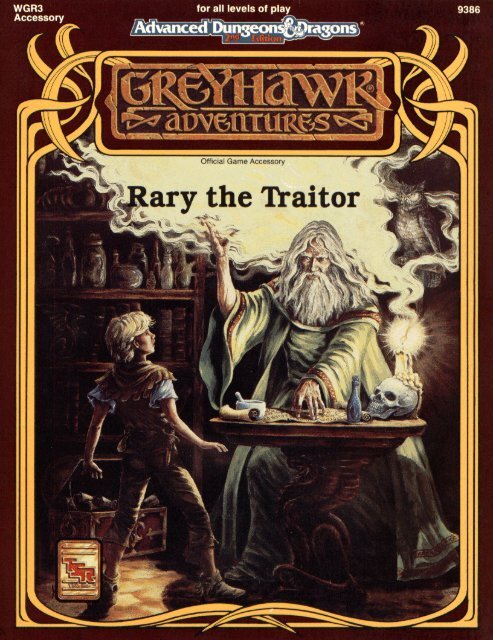
Rary the Archmage, Rary the Traitor. 

When my brother introduced me to AD&D, he lended me the campaign materials he had collected. These consisted of the old 2nd Edition Greyhawk Boxed sets, accompanied by Sargent-era sourcebooks. One of those was Rary the Traitor. 


At the time, I didn't "get" Rary. A powerful wizard who for no reason at all betrayed his friends and allies, even murdering two of them and setting up his own empire for the evulz? No. Sure, the World of Greyhawk is filled with megalomaniacal villains, but at least Iuz the Old and the Scarlet Brotherhood were interesting. Rary was just... lame, I guess.

Until I discovered the amount of lore produced for the Living Greyhawk storyline Blight On Bright Sands. Suddenly, Rary became a well-intentioned extremist. His nemeses misguided. The goal of the story arc, salvation for an ancient kingdom and thwarting the machinations of a dark god. 

Yesterday, I mentioned that my next campaign must be set in the Flanaess. Now, I have my master villain and my sandbox.

dinsdag 3 december 2019

Coming Home


While creating the ARCANA setting, something clicked. I was looking for a way to justify all the spells and magic items named after major NPC's. Then I stumbled upon Greyhawk Grognard's version of Western Oerik (the lands beyond the Greyhawk setting) and then it dawned on me: what if, instead of developing an entire new world, I'd use the undeveloped lands west of the Flanaess as the setting for Aurora, Palladium and the magical races and places I designed? It would explain why Floating Disc is named after Tenser and the Iron Flask bears the name of Tuerny the Merciless.

In doing so, I started reading up on Greyhawk again, the first AD&D setting I DM'ed and I immediately fell in love all over again. Since then, I have reread the Greyhawk sourcebooks I own, researched online, joined Canonfire and perused the enormous catalogue of adventures developed for the Living Greyhawk campaign.

I will continue to develop the lands of Aurora and Palladium, this time in Western Oerik. But my next campaign has to be set in the Flanaess.

zondag 24 november 2019

Greyhawk, Birthright, The Balance and the Old Faith

When searching the blogosphere on what makes the World of Greyhawk unique as a setting, sometimes the answer "militant neutrality" is given. See this thread and here as examples. In the EN World thread, this passage in particular summarizes it best:

Greyhawk is not concerned with the triumph of good over evil. The very nature of the evils loose on Oerth makes such triumphs fleeting at best. Greyhawk endures evil and circumvents it. It does not defeat it.
And:

Perhaps accounting for all of this, Oerth has strong and active neutrally aligned forces, working to preserve a balance between good and evil. While hardly organized, these forces nonetheless manage to be quite effective. The Circle of Eight, mighty wizards all, seeks a middle path. Istus, the divine Lady of Fate, tests all but favors none. Druids are a quiet but ever present presence. Indeed, many of Greyhawk's deities reflect a distinct neutral bent.

In Gygax's Gord novels, the hero is heralded as Champion of Neutrality. And other protagonists are all of a distinctively neutral bent. What is more, Mordenkainen, Gygax' original Player Character, is an active proponent of the Balance and leader of the Circle of Eight. The demigod Zagyg, Gygax' author avatar in the infamous Castle Greyhawk, is Chaotic Neutral and serves Boccob, the god of magic and non-interventionism.

Erik Mona, in Living Greyhawk #0, describes Mordenkainen's militant neutrality as follows:

Mordenkainen's view of "enforced neutrality" is not a tit-for-tat equality but rather a detailed theoretical philosophy derived from decades of arcane research. He has fought ardently for the forces of Good, most recently during the Greyhawk Wars, but just as often has worked on darker plots to achieve his ends.
Ever since reading that quote, I wondered what this theoretical philosophy composed of arcane research would be. As I am preparing to shift my campaign over to Oerth after completing my current campaign in the Sunset Realm, my attention was drawn to this conundrum.

I have concluded that, in *my* Greyhawk, the Balance propagated by both Beory and Boccob is one and the same: a balance of nature and natural forces, neither good nor evil, necessary for the flow of lifeforce and arcane magic. Mordenkainen's arcane research delved into ley lines, arcane energy and the necessity for not one civilizing power to gain dominance, for the development of civilization on a grand scale would limit the flow of arcane energy. The druids of the Old Lore agree with this basic insight, but disapprove of the sole focus on arcane magic, rather taking the perspective that all natural life must flow unopposed by civilization.

What do you think is at the foundation of Mordenkainen's philosophy? And why do the Druidic Hierophants disagree with him? I would love to read your views in the comments!

woensdag 17 oktober 2018

Grease and Blood

...or "Why I love Greyhawk".

As Erik Mona, formerly of Dragon Magazine, now of Paizo, has put it once before: "Greyhawk is my favourite setting, because grease and blood are better than high fantasy and high magic". I happen to agree.

Greyhawk was the first TSR setting for Dungeons & Dragons. And while many falsely assume it is a high fantasy setting reminiscent of Middle Earth or even the Forgotten Realms (gasp!), nothing could be further from the truth.

When you look up Gygax's Appendix N in the back of the 1st Edition DMG, there is only a handful of high fantasy literature on there. The majority of the list is made up of pulp fantasy: Robert E. Howard's Conan, Clark Ashton Smith, H.P. Lovecraft, Moorcock. Fritz Leiber's Nehwon stories. All examples of sword & sorcery pulp adventure.

What is more, the early Greyhawk modules such as the Village of Hommlet, the Temple of Elemental Evil, the Giants/Drow series, the Slavers-series, all are examples of small-scale sword & sorcery fantasy - not the epics and high magics that define high fantasy!

Greyhawk's tone is dark. There is an evil demigod that rules an empire to the north. The main city of the setting is steeped in greed and corruption and ruled by a kleptocracy of thieves. The fading empire is mired in diabolism and decadence. The Elves, Dwarves, Gnomes and Halflings of the setting are isolated enclaves beset by savage humanoids. And the good nations of the world are internally divided and occupied with their defense. This is not a setting of shining knights and epic magic, this is a setting where the might of small adventuring bands make small gains against the encroaching dark gods, slaving racists and decadent nobles.

When I was younger and just discovering D&D, I did not grasp this subtlety. Greyhawk City, Furyondy, the Empire of Iuz, the Great Kingdom - they were all backdrops for our World Tour Adventure, a sandbox of six 14-year olds cavorting through the setting and meeting as many named NPCs as possible.

But in the years since, I have come to admire the exquisite craftsmanship of this setting and the way in which it truly stands apart from Forgotten Realms' high fantasy and Dragonlance's epic fantasy. In a way, it is small fantasy. Not low fantasy, as powerful spells and magic items are still common. But Greyhawk is not about powerful NPC's sweeping in to save the day from marauding gods. Nor is it about an epic war agains evil dragons. Greyhawk is about the very human possibility to make a small change for the better in the world. And you can give me that any day.