zondag 24 november 2019

Greyhawk, Birthright, The Balance and the Old Faith

When searching the blogosphere on what makes the World of Greyhawk unique as a setting, sometimes the answer "militant neutrality" is given. See this thread and here as examples. In the EN World thread, this passage in particular summarizes it best:

Greyhawk is not concerned with the triumph of good over evil. The very nature of the evils loose on Oerth makes such triumphs fleeting at best. Greyhawk endures evil and circumvents it. It does not defeat it.
And:

Perhaps accounting for all of this, Oerth has strong and active neutrally aligned forces, working to preserve a balance between good and evil. While hardly organized, these forces nonetheless manage to be quite effective. The Circle of Eight, mighty wizards all, seeks a middle path. Istus, the divine Lady of Fate, tests all but favors none. Druids are a quiet but ever present presence. Indeed, many of Greyhawk's deities reflect a distinct neutral bent.

In Gygax's Gord novels, the hero is heralded as Champion of Neutrality. And other protagonists are all of a distinctively neutral bent. What is more, Mordenkainen, Gygax' original Player Character, is an active proponent of the Balance and leader of the Circle of Eight. The demigod Zagyg, Gygax' author avatar in the infamous Castle Greyhawk, is Chaotic Neutral and serves Boccob, the god of magic and non-interventionism.

Erik Mona, in Living Greyhawk #0, describes Mordenkainen's militant neutrality as follows:

Mordenkainen's view of "enforced neutrality" is not a tit-for-tat equality but rather a detailed theoretical philosophy derived from decades of arcane research. He has fought ardently for the forces of Good, most recently during the Greyhawk Wars, but just as often has worked on darker plots to achieve his ends.
Ever since reading that quote, I wondered what this theoretical philosophy composed of arcane research would be. As I am preparing to shift my campaign over to Oerth after completing my current campaign in the Sunset Realm, my attention was drawn to this conundrum.

I have concluded that, in *my* Greyhawk, the Balance propagated by both Beory and Boccob is one and the same: a balance of nature and natural forces, neither good nor evil, necessary for the flow of lifeforce and arcane magic. Mordenkainen's arcane research delved into ley lines, arcane energy and the necessity for not one civilizing power to gain dominance, for the development of civilization on a grand scale would limit the flow of arcane energy. The druids of the Old Lore agree with this basic insight, but disapprove of the sole focus on arcane magic, rather taking the perspective that all natural life must flow unopposed by civilization.

What do you think is at the foundation of Mordenkainen's philosophy? And why do the Druidic Hierophants disagree with him? I would love to read your views in the comments!

dinsdag 13 augustus 2019

Once more into the breach

Greetings!

So the past two months have been slow. Combination of beginning a new job and a second baby being born. But my werewithal to our roleplaying hobby has not faltered! This blog is not dead, expect more content soon (if intermittent).

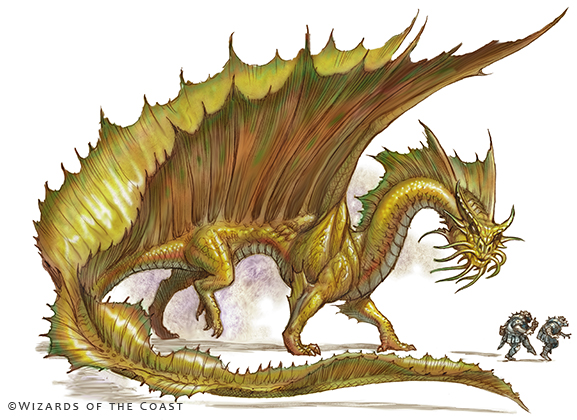
Parley between a Gold Dragon and two Elves

"A dragon! An ancient one, by the looks of it. Gold." Prince Leolar's eyes went wide. Although he had seen dragons before in his years, even fought and survived them, never before did he witness as magnificent a creature as now descended from the twilit sky amidst the Elven forces. All around him, the Elven Citizen Guards threw down their polearms and shields as they fled in terror from the great golden foe. Leolar felt his legs beginning to quiver, an acid taste at the back of his mouth. His shield slipped from his grasp. He became aware of a warm feeling in his groin area.


"Don't worry, its perfectly natural, it could happen to anybody." The voice was cool, distant. The voice of his Queen, his Lady, Ylsandre of the Ageless Ashtree. Leolar didn't know if the comment was referencing him wetting his breeches or their men fleeing the field.

The dragon landed ahead of them, generating a gale that threw the Elven siege engines on their sides. When it landed, it crouched low to the ground, flattening its wings. But then it rose, sitting back on two feet and uncoiling, like a great golden serpent spreading the dawn. The red twilight sunlight gleamed on the golden scales of the dragon. Its eyes blazed with an azure light. Golden radiance filled the fields around Antissa, a feeling equal measures serenity and dread spread from the dragon. As fear of the dragon and panic spread throughout the besieging Elven forces, Leolar felt increasingly lonely.

"It seems we are not left a choice," Queen Ylsandre said. Her violet eyes gazed adamantly upon the gold dragon. "We should..."

A roar boomed, echoing off the walls of Antissa, the dragon, finally announcing its presence.

"GREETINGS, MORTALS. I HAVE BEEN SENT BY HE WHO JUDGES. MY NAME IS GRUEMAR, I AM THE VOICE. AND I HAVE ONE REQUEST. WITHDRAW. CONCEDE TO THIS REQUEST, OR SUFFER THE CONSEQUENCES."

Leolar found it increasingly hard to swallow. "What should we do?" The possibility of defeat hadn't entered his mind when they encircled Antissa, home of the hated humans that left the Elven people to rot. But now...

Ylsandre answered. "What else can we do? We should give noble Gruemar what he wants. After all, he is an emissary of the gods. I will offer myself up as hostage."

That took Leolar aback. "Hostage? But you are of the old blood! What about..." Ylsandre interrupted him.

"Indeed I am. But it will secure free passage for our kin. And as one door closes, other doors may open." Ylsandre, Queen of the Ageless Ashtree, strode forward into reach of Gruemar the Voice of Bahamut, the imposing ancient Gold Dragon. Leolar found his shield, preparing for a new journey.

maandag 10 juni 2019

Missives from the Sunset Realm

News on the streets of Aurora:

Pillars of Skulls rise in the deserts
In the southern desert known as the Zaar, caravans have reported construction on massive pillars composed of skulls. Attempts at interaction with the construction crews have all met with sullen silence. The purpose of the horrific edifices has yet to be unveiled. Rumours in the cities of the Sjikah Republic all point to a directive from Niveneh. Arkhon Akhemen remains silent on the matter however.

Iron Circle joins Minos army
The Iron Circle mercenary group, operating out of the Forbidden Valley, has joined forces with the minotaur Elite Guard of Minos. The army is currently marching south toward Antissa in order to lift the siege of that beleaguered city. At its current pace, the army is expected to arrive at Antissa's walls in about a moon's time.

vrijdag 7 juni 2019

Races of ARCANA - part 2

Continuing from this earlier post, lore of the Player Character Races of ARCANA.

D&D, over its various editions, has always had a large cast of anthropomorphic animals: Gnolls, Sahuagin, Bugbears, Lizardfolk, Bullywug. In the past, with my interest firmly fixed on grimdark or sword & sorcery worldbuilding, I rarely found much use for these types of races, even as monstrous foes.

However, since Arcana is meant to be inspired by saturday morning cartoons and animalfolk inhabit the Western Kingdoms alongside Humans, Elves and Dwarves, the various anthropomorphic races in the Monster Manual and other sources can be reskinned as follows:

Aarakocra: These birdfolk can take the shape of various avian species, such as eagles or owls.
Bugbears: The bearfolk of Arcana are strong but can also be stealthy. They are as likely to take up axes and hammers in war, as they are innocent or adventurous.
Bullywugs: The frogfolk inhabit rivers, marshes and wetlands.
Giff: The hippofolk are a culture of distinguished and martial people, inhabiting southern regions.
Gnolls: These hyenafolk are often predatorial and carrion-eaters.
Kenku: The ravenfolk are a disctinct species of birdfolk, drawn to urban locations.
Kuo-Toa: The fishfolk of the seas are drawn to dark arts.
Lizardfolk: These savage reptilefolk live peaceful lives in swampy areas.
Loxodon: The elephantfolk of the distant South and East are rarely seen in the Western Kingdoms.
Minotaur: The bullfolk are strong and have a martial culture.
Neogi: These spiderfolk are feared throughout the Western Kingdoms as merchants of death and slavers.
Sahuagin: The sharkfolk of the seas and oceans, often at war with the fishfolk but possessed of an advanced culture.
Tabaxi: In most urban areas of the Western Kingdoms, these catfolk can be found.
Thri-Kreen: Relatively rare, these insectfolk mostly inhabit the deserts to the East.
Tortle: The turtlefolk lead mostly nomadic and lone lives.
Yuan-Ti: Heirs of an old empire, the snakefolk are oftentimes portrayed as evil.


Missing from this list are a few standard anthropomorphic animals:

Wolfmen
Foxfolk
Lionfolk
Rabbitfolk
Tigerfolk
Boarfolk
Dogfolk

Expect these races to appear in a future post.

woensdag 5 juni 2019

Races of ARCANA - part 1

Lore of the Player Character Races in the World of ARCANA

Elves
The Elves of Arcana are not native to the world. They are Eldar – Starborn in their language – and they came from another world in the Dark Beyond. That world was consumed by the Voidstar, which the Eldar call Tharizdun, an abomination of their own making. Through the misuse of the magic of their Sun, it was warped into the Voidstar. Now, the Elves on Arcana are the only remnant of their once proud starfaring race – and determined to not repeat the mistakes of the past. Mostly.
Half-Elves are prominent in one of the Western Kingdoms, where the Human knights and nobles usurped a High Elven citadel in order to secure its magic. It has given rise to a large number of Half-Elves. The Humans are still searching for the secret magic.


Dwarves
The Dwarves of Arcana were, according to their myths, created by the Lord of Fire and Forge. The Dwarven Kings are celebrated as freedom fighters and just rulers that successfully freed their people from captivity by the Elves after the War in Heaven.


Halflings
No one actually knows where Halflings came from. They have no recognized homeland, no creation myth, no kingdom and no culture. They are universally recognized as roamers and wanderers – appropriating anything yet denying responsibility for everything. Their secretive past is the object of many Halfling adventures.


Gnomes
As the Eldar spread out across Arcana and established their magical empire, they found many fey nature spirits. Determined to never repeat the mistakes of the past and to work in harmony with nature, the Eldar befriended these spirits. Through friendship, through association and magic, these fey took on more stable form and became the Gnomes.


Orcs and Half-Orcs
Arcana’s Orcs were created by Phaeton from Elves. Their hatred of Elvenkind is in the blood and they represent everything the Elves fight against: brutality, aggression, barbarism. Even so, two generations ago, the Western Kingdoms recruited Orcs massively as labor for their great public works and tilling the fields. As a consequence, there are Orc ghettoes in large cities. Half-Orcs are looked upon as second- or third-generation immigrants. The salvation of Orc-kind and their Half-Orc descendants from the bonds of Phaeton, however, does lie in the cities of the humans. Only through redemption can they wrest themselves free from the bonds of savagery.


Tieflings
Phaeton's corruption did not stop with the Orcs and Goblins. A Human tribe was seduced to the side of Fire by the Lightbringer's schemes. Before the days of the Dragon Empire, this tribe, infused with Infernal blood, dominated an ancient kingdom. Nowadays, the Tieflings are scattered across Arcana.


Dragonborn
Created from Dragon eggs in the time of the Dragon Empire, the Dragonborn are the favored sons and daughters of Dragonkind. Together with humanity, they dominated the world in the time of the last great empire. Now their kind can be found anywhere in the Western Kingdoms.

maandag 3 juni 2019

The Siege of Antissa part 4 - The Forces Entrench Themselves

As weeks pass in my Sunset Realm game, the siege of Antissa, its freest city, continues.

To remind you, dear reader, of the situation: the High Elves of Silvanor Forest were driven out of their home cities of Benerel Nodel and Benerel Adon. For some reason, they hold humanity to blame and have therefore marched on the most nearby human capital: Antissa.

As they arrived and settled in, the King of Antissa, King Kenneth, sallied forth and claimed first blood.

Now, the siege has dragged on for another two weeks.

I have been using the War Machine rules to adjudicate the siege.

The Second Week
In the siege's second week, the Elves see their food supply diminished. They can only last this and next week and will have to force a decision in the fourth week of the siege. Antissa, meanwhile, still has enough food supplies for 65 weeks and can afford to sit out the Elves' attacks.

Still being outgunned by Antissa's siege defenses, the Elves choose to have another round of siege engine construction. Evander orders the construction of three trebuchets, further boosting the BR of his force by +36.

Kenneth, flush with his first victory, orders another round of harrassments. Rolling 1d100, Kenneth gets a result of 97, for a total of 267. Evander rolls 71 for a total of 231 - another win for Antissa. Looking up the difference in the Battle Results Table, a 36 gives the following:

Casualties: 2% for the Winner, 4% for the Loser
Fatigue: Moderate Fatigue for the Winner, Serious Fatigue for the Loser

As such, the Elves' active battle roster is reduced to 3,800 battle-ready elves and seriously fatigued. After 1 day (I rolled a 1 on 1d4), the Elves become moderately fatigued, which they remain for three days. After a week, the Elves are again restored to their normal strength.

Antissa's forces have been reduced from 6,100 to 5,980, all of whom are moderately fatigued. Two days later, their fatigue vanishes.

The Third Week
The Elves, seeing their food supplies dwindle, decide to bombard Antissa. Evander has four heavy catapults (+32) and three trebuchets (+36) for a total BR of 228. Antissa has a siege engine BR of 195.

When bombarding, the result of the week are determined by rolling 1d10 and multiplying the result by 10. That yields the number of hit dice as casualties as a percentage of the BR.

Evander rolls an 8, causing 80% of 228 = 182 civilian casualties.
King Kenneth rolls a 7, causing 70% of 195 = 136 elven casualties.

At the end of the third week of the siege, the Elves have suffered 236 casualties with another 100 wounded. The forces of Antissa have suffered 60 casualties with another 60 wounded, and another 136 civilian casualties.

Divine Intervention
High Ecclesiarch Terenas continues to pray for Divine Intervention during the second and third week of the siege. . His prayers are finally heard just three days before the end of the third week, after the first wave of bombardment has taken place. Bahamut, Terenas' patron deity, sends one of seven great gold dragons that serve him to negotiate a truce. Gruemar the Voice, a massive and ancient gold dragon, descends from the heavens amidst the Elven forces and negotiates for a peaceful end to the siege. The end-result of this negotiation has yet to be determined.